Georgia’s Career Pipeline is a resource developed by the Georgia Department of Education’s Office of Career, Technical, and Agricultural Education (CTAE) to help highlight talent development by district and help businesses make decisions based on their growth and workforce development needs.
Georgia’s Career Pipeline is divided into four sections:
- Explore Future Workforce: This section contains CTAE pathway enrollment data for every high school in Georgia.
- Workforce Needs: Labor market information is a key resource for workforce development decision making. This section contains links to labor market data resources.
- FAQ: This section contains additional user resources and common questions.
- Pipeline Resources: There are a number of additional resources for CTAE talent stakeholders contained on the pipeline resource page.
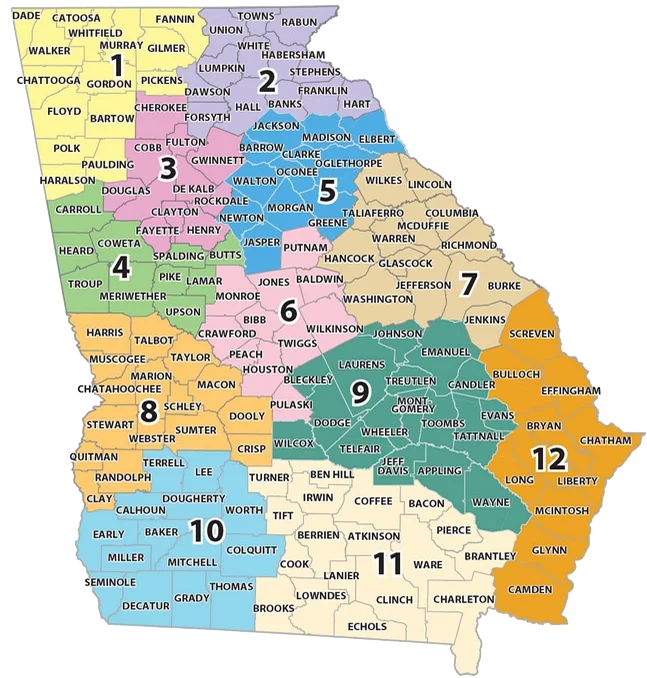
Region 1: Northwest Georgia (Dade, Catoosa, Walker, Whitfield, Murray, Chattooga, Floyd, Bartow, Polk, Paulding, Haralson, Fannin, Pickens, Gilmer, Gordon)
Region 2: Georgia Mountains (Union, Towns, Rabun, Lumpkin, White, Habersham, Dawson, Hall, Banks, Stephens, Forsyth, Franklin, Hart)
Region 3: Atlanta Regional Commission (Cherokee, Cobb, Fulton, Douglas, DeKalb, Fayette, Clayton, Rockdale, Henry, Gwinnett)
Region 4: Three Rivers (Heard, Coweta, Troup, Meriwether, Pike, Spalding, Butts, Lamar, Upson, Carroll)
Region 5: Northeast Georgia (Jackson, Madison, Elbert, Clarke, Barrow, Oconee, Morgan, Newton, Greene, Oglethorpe, Jasper, Walton)
Region 6: Middle Georgia (Putnam, Monroe, Jones, Baldwin, Bibb, Wilkinson, Crawford, Peach, Houston, Twiggs, Pulaski)
Region 7: Central Savannah River Area (Wilkes, Lincoln, Taliaferro, Warren, McDuffie, Columbia, Richmond, Glascock, Hancock, Jefferson, Washington, Burke, Jenkins)
Region 8: River Valley (Macon, Dooly, Harris, Talbot, Taylor, Crisp, Muscogee, Chattahoochee, Marion, Schley, Stewart, Webster, Sumter, Quitman, Randolph, Clay)
Region 9: Heart of Georgia Altamaha (Johnson, Laurens, Treutlen, Emanuel, Bleckley, Dodge, Wheeler, Montgomery, Toombs, Wilcox, Telfair, Candler, Jeff Davis, Appling, Evans, Tattnall, Wayne)
Region 10: Southwest Georgia (Terrell, Lee, Worth, Dougherty, Calhoun, Early, Baker, Mitchell, Colquitt, Miller, Seminole, Decatur, Grady, Thomas)
Region 11: Southern Georgia (Turner, Tift, Ben Hill, Irwin, Coffee, Bacon, Pierce, Atkinson, Berrien, Cook, Lowndes, Echols, Clinch, Charlton, Brantley, Brooks, Lanier, Ware)
Region 12: Coastal (Screven, Bulloch, Effingham, Bryan, Chatham, Long, Liberty, McIntosh, Glynn, Camden)
Georgia has 17 Career Clusters. Each cluster has multiple Career Pathways. For example, the Hospitality & Tourism Cluster has three Pathways, which are Culinary Arts; Hospitality, Recreation & Tourism; and Sports & Entertainment Marketing. To complete a Pathway, students must successfully complete three courses. Georgia’s career instructional initiative is based on the National Career Cluster Model.
To become a Pathway completer, a student must successfully complete three courses in the same Pathway.
- Commitment
- Education
- Leadership
- Recognition
- Teamwork
- Conviction
- Integrity
- Professionalism
- Service
The ten CTSOs are listed and described below:
CTI (Career Technical Instruction)
Career and Technical Instruction (CTI) is designed to support students with disabilities enrolled in Career, Technical, and Agricultural Education classes. The CTI program provides students with disabilities at the secondary level entry-level job skills in broad or specific occupation clusters. CTI offers a Fall Leadership Conference that focuses on students with disabilities in CTAE classes in high schools throughout Georgia. The purpose of the program is to reward students showing the greatest improvement in career and work adjustment skills and to recognize the achievement of these students in their career, technical and agricultural programs.
Applicable Pathways: All CTAE Career Clusters and Pathways
Georgia: https://www.georgiacti.org
DECA
DECA is specifically designed to provide activities for students to learn marketing, management, and entrepreneurial skills that will prepare them to pursue a career in the field of marketing. DECA members become more aware of the value of community service; participate in local, state, and national competitive events programs that showcase student skills and allow for interaction with the business community; further develop occupational skills needed for careers in marketing, management, and entrepreneurship; serve in leadership roles; and develop a greater understanding of our competitive, free-enterprise system and an appreciation of the responsibilities of citizenship.
Applicable Pathways: Marketing, Finance, Hospitality & Tourism, Business Management & Administration
Georgia: https://www.gadeca.org
National: https://www.deca.org
ENGAGE
Applicable Pathways: All pathways within the Public Safety and Services Career Cluster.
FBLA (Future Business Leaders of America)
Future Business Leaders of America (FBLA) is a student organization for all middle and high school students participating in business programs. As an integral part of the business instructional program, FBLA provides opportunities for students to develop vocational and career-supportive competencies. Participation in FBLA activities promotes civic and personal responsibility, helps students develop business leadership skills and establish career goals, and prepares them for useful citizenship and productive careers.
Applicable Pathways: Administrative/Information, Financial Management – Accounting, Interactive Media, Computer Networking, Support Computing, Small Business Development, Computer Systems & Support, Financial Management – Services
Georgia: https://georgiafbla.org
National: https://www.fbla-pbl.org
FCCLA (Family, Career, and Community Leaders of America)
Family, Career, and Community Leaders of America (FCCLA) is a national student organization that helps young men and women become leaders and address important personal, family, work, and social issues through family and consumer sciences education. Through cooperative and competitive programs, FCCLA members develop skills for life including character development, creative and critical thinking, interpersonal communication, practical knowledge, and career preparation. Participation in national programs and co-curricular chapter activities enables FCCLA members to learn cooperation, take responsibility, develop leadership, and give service.
Applicable Pathways: Family and Consumer Sciences, Interior Design, Culinary Arts, Education, Human Services
Georgia: https://www.georgiafccla.org/
National: https://fcclainc.org
FFA
Georgia FFA is an integral component of the agricultural education program. It is the student development and leadership application portion of agricultural education. FFA offers a variety of experiential learning opportunities through competitive proficiency awards and career development events. Competitions focus on leadership and public speaking, communications, agriscience, and biotechnology, as well as production agriculture. Agricultural education teachers and FFA advisors stress problem solving and decision making through hands-on activities. By applying a science based curriculum learned in a classroom to real life projects, teamwork, and competition, FFA members develop into successful, productive citizens.
Applicable Pathways: Agriscience, Plant Science / Horticulture, Forestry / Natural Resources, Agribusiness Management, Agriculture Mechanics, Veterinary Science, Animal Science
Georgia: https://www.georgiaffa.org
National: https://ffa.org

GA First Robotics
Founded in 2012, our vision is to see kids excited about science and technology, have them attend one of our prestigious institutes of higher learning, and upon graduation, stay in Georgia for their careers. Our best resource, our youth, contribute to the growth and sustainability of our innovative workforce.
Georgia: https://gafirst.org/
HOSA, future health professionals
HOSA’s mission is to enhance the delivery of compassionate, quality health care by providing opportunities for knowledge, skill, and leadership development of all health occupations students. Students are enabled to meet the needs of the health care community.
Applicable Pathways: Diagnostic Services, Therapeutic Services-Medical, Health Informatics, Physical Medicine, Therapeutic Services-Emergency, Biotechnology Research & Development, Therapeutic Services-Nursing
Georgia: https://georgiahosa.org
National: https://hosa.org
SkillsUSA
Georgia SkillsUSA members participate in local, state, and national activities provided through trade and industrial, technical, and health occupations courses and programs. The mission of SkillsUSA is to develop leadership skills and workplace competencies that students will need to succeed in a constantly changing global workplace. The organization provides many opportunities for leadership development and skills training. Competition in over 70 leadership, health occupations, occupationally related, and trade, industrial, and technical contests is offered at the region and state levels, culminating with the national SkillsUSA Championships each June.
Applicable Pathways: Aircraft Support, Architecture Drawing and Design, Collision Repair, Broadcasting/Video Production, Construction, Climate Control Systems Technology(HVACR), Fire Fighting, Cosmetology, Flight Operations, Marine Engine Technology, Graphic Communications, Graphic Design, Law and Justice, Maritime Studies, Metals, Personal Care Services, Homeland Security & Emergency Services, Transportation Logistical Support(Ground/Marine), Transportation Logistical Operations(Ground/Marine)
Georgia: https://www.skillsusageorgia.org
National: https://www.skillsusa.org
TSA (Technology Student Association)
The Technology Student Association (TSA) is committed to providing students with opportunities to excel and advance as part of their instruction in technology education. Georgia TSA promotes technology education as a means of preparing students for a dynamic world, inviting them to become critical thinkers, problem solvers, and technologically literate leaders. The mission of GA TSA is to prepare its members to be successful leaders and responsible citizens in a technological society through co-curricular activities with the technology education program, thereby developing communication, leadership, and competitive skills.
Applicable Pathways: Electronics, Engineering, Manufacturing Energy Systems, Engineering Graphics &
Credentials of Value (COV) are industry-specific assessments that show evidence of students’ attainment of technical skills to successfully perform job-related tasks. Each Career Pathway may have several approved assessments.
Work-Based Learning (WBL) provides students the opportunity to receive credit while working in an environment related to their Career Pathway. WBL placements represent the pinnacle of the Career-Related Education experience. To qualify for a WBL placement, a student must be in grades 10, 11, or 12 and at least 15 years of age. Students must also have a defined Career Pathway in order to participate in a WBL placement. This is especially important for successful completion of a student’s pathway in that their job placement is directly related to the curriculum of the pathway classes they have completed or in which they are concurrently enrolled. There are several opportunities for students to participate in WBL. These opportunities include Employability Skill Development, Cooperative Education, Internship, Youth Apprenticeship and Great Promise Partnership.
Youth Apprenticeship is a structured combination of school-based and work-based learning. Through a coordinated effort involving business and industry, Youth Apprenticeship addresses the dual role of preparing students for the world of work and providing Georgia with a highly skilled, technologically competitive workforce. A student participating in the Youth Apprenticeship Program receives an education that is both academically challenging and relevant to employment in today’s economy. The program enables a student to receive a high school diploma, a post-secondary certificate or degree, and certification of industry-recognized competencies applicable to employment in a high-skilled occupation.
Essential components of Georgia’s Youth Apprenticeship Program are:
- a partnership structure involving secondary schools, post-secondary institutions, employers, and community representatives;
- structured linkage between secondary and post-secondary components, leading to a high school diploma and post-secondary credential; and
- academic and vocational classroom instruction combined with on-the-job learning experiences.
Work-Based Learning includes the development of a detailed training plan between the employer and apprentice; identification of specific work tasks that will develop workplace competencies; a minimum of 720 hours of on-the-job training; workplace mentoring; and instruction in general workplace competencies as well as all aspects of a chosen industry. School-based instruction includes selection of a Career Pathway; related coursework; placement on a related job; periodic evaluations; and ongoing guidance. While most students complete three courses related to a connecting Pathway, all students must earn a minimum of one unit of credit before placement on the job site.
In addition to meeting the required guidelines to be a part of the Youth Apprenticeship Program, students are also expected to excel in these three areas:
- academic performance
- school and workplace behavior
- job performance
Once the student has excelled in the aforementioned areas, there are still three critical elements that must be in place before a Youth Apprenticeship student can truly experience an authentic work-based learning experience.
Those three elements are:
- the mentor (someone who provides guidance and encouragement to student),
- student evaluations (done by the employer and serves as an assessment tool for the student’s job performance), and
- professional portfolios.
Georgia’s Dual Enrollment Program provides funding for students who are dually enrolled at a participating eligible public or private high school, or home study program in Georgia, and a participating eligible postsecondary institution in Georgia. These students take postsecondary coursework for credit towards both high school graduation or home study completion and postsecondary degree, diploma, or certificate requirements. The program is offered during all terms of the school year: fall, spring and summer semester or fall, winter, spring and summer quarter.
Please visit the Fourth Science Course Option 2025-2026 course list.
Below is a list of commonly used acronyms:
A
- ABC – Associated Builders and Contractors
- ACTE – Association for Career and Technical Education
- AECA – Atlanta Electrical Contractors Association
- AGC – Associated General Contractors
- ARC – Atlanta Regional Commission
B
- BRIDGE (Building Resourceful Individuals to Develop Georgia’s Economy) Act –
- House Bill 400 passed in 2010 that mandates that all 6th, 7th, and 8th grade students complete career-related interest inventories, research careers of interest, and create an Individualized Graduation Plan before transitioning to high school with counselor and parent agreement and sign-off.
C
- CCRPI – College and Career Ready Performance Index
- CEFGA – Construction Education Foundation of Georgia
- CTAE – Career Technical & Agricultural Education
- CTAERN – Career Technical & Agricultural Resource Network
- CTAERN.org –
- The CTAE Resource Network is a statewide organization supporting Career, Technical, and Agricultural Education initiatives in Georgia’s public school
- CTAE Industry Certification –
- When a program became industry certified, it received a “stamp of excellence”, which represents the apex of program quality. Only those programs that have successfully undergone rigorous reviews by leaders from business and industry are recognized with this distinction. The State Department of Education is committed to the industry certification process as a part of its effort to strengthen technical and academic standards for all Career, Technical and Agricultural Education (CTAE) programs.
- CTI – Career Technical Instruction –
- Refers to the Career and Technical Student Organization for students with disabilities enrolled in Career, Technical and Agricultural Education classes. The goal of the secondary level services is to provide these students with job-entry skills at the completion of the CTAE experience.
- CTSO – Career and Technical Student Organization –
- Georgia currently offers CTSO experiences for students in CTI (Career Technical Instruction, DECA (An Association of Marketing Students), FFA, FBLA (Future Business Leaders of America, FCCLA (Family, Career and Community Leaders of America), Georgia SkillsUSA, Georgia Technology Student Association, Georgia HOSA future health professionals, and Georgia FIRST Robotics.
D
- DECA –
- as the Career and Technical Student Organization for Marketing Education. The proper name is referred to as Georgia DECA. DECA prepares emerging leaders and entrepreneurs in marketing, finance, hospitality and management.
- DJJ – Department of Juvenile Justice (Georgia)
E
- ECP – Education and Career Partnership
- This is the umbrella term for student participating dual enrollment/dual credit programs, such as Move On When Ready.
- EOC – Milestones End of Course test
- COV – Credentials of Value Assessment
- Pathway Completer – A student who has completed three sequential/required courses in a career pathway and sat for an industry recognized exam to gain industry credentials or test results that prove competency in varied skills/trades; through test vendors such as: NOCTI, SkillsUSA, National Automotive Student Skills Standards Assessment.
- ESD – Employability Skill Development
F
- FACS – Family and Consumer Sciences
- FBLA –
- Refers to Future Business Leaders of America, as the Career and Technical Student Organization for Business Management and Administration, Finance, and Information Technology education. The proper name is referred to as FBLA. A postsecondary organization known as FBLA-PBL for students to continue their leadership and technical skill development.
- FCCLA –
- Refers to Family, Career, and Community Leaders of America, as the Career and Technical Student Organization for Education and Teaching, Hospitality and Tourism, and Human Services and middle school Family and Consumer Sciences education. The proper name is referred to as FCCLA.
- FIRST Robotics –
- A Career and Technical Student Organization devoted to engaging students in science, engineering, and technology skills that inspire innovation, self-confidence, communication and leadership. The proper name is GeorgiaFIRSTRobotics.
- FFA –
- as the Career and Technical Student Organization for Agriculture Education. The proper name is referred to as FFA.
G
- GAM – Georgia Association of Manufacturers
- GaDOE – Georgia Department of Education
- GaDOL – Georgia Department of Labor
- GAIEF – Georgia Apartment Industry Education Foundation
- GACTE – Georgia Association for Career and Technical Education
- GCIS – Georgia Career Information System
- GEICC – Georgia Energy and Industrial Construction Consortium
- GOWD – Governor’s Office of Workforce Development
- GSFC – Georgia Student Finance Commission
- GUCA – Georgia Utility Contractors Association
H
- HEQ – Heavy Equipment
- HOSA, future health professionals –
- as the Career and Technical Student Organization for Healthcare Science Education. The proper name is referred to as Georgia HOSA, future health professionals.
I
- IEC – Independent Electrical Contractors
- IDEA – Individuals with Disabilities Education Act
M
- MAG – Masonry Association of Georgia
- MCA – Mechanical Contractors Association
N
- NATP – Nurse Aide Training Program
- NCDG – National Career Development Guidelines
- NTHA – National Technical Honor Association
P
- POW – Program of Work
- Outlines the activities to be performed beyond the school day. The POW exists as an extension of the teacher’s profile on the CTAE Resource Network (CTAERN) website.
S
- SkillsUSA –
- Refers to the Career and Technical Student Organization for Trades and Industrial education, including cosmetology, healthcare, all areas of construction, welding, automotive, aviation, and public safety. The proper name is referred to as Georgia SkillsUSA.
- SBOE – State Board of Education
T
- TAA – Teachers as Advisors
- TABE – Test of Adult Basic Education
- TCC – Technical Certificate of Credit
- TCSG – Technical College System of Georgia
- TEFGA – Transportation Education Foundation of Georgia
- TSA –
- Refers to Technology Student Association, as the Career and Technical Student Organization for Science, Technology, Engineering and Mathematics, Manufacturing, and Energy education. The proper name is referred to as GeorgiaTSA.
U
- USDOE – United States Department of Education
- USG – University System of Georgia
- USGBC – United States Green Building Council
W
- WBL – Work-Based Learning
- WIOA – Workforce Innovation and Opportunity Act
- WIP – Workforce Incentive Plan
Y
- YAP – Youth Apprenticeship Program